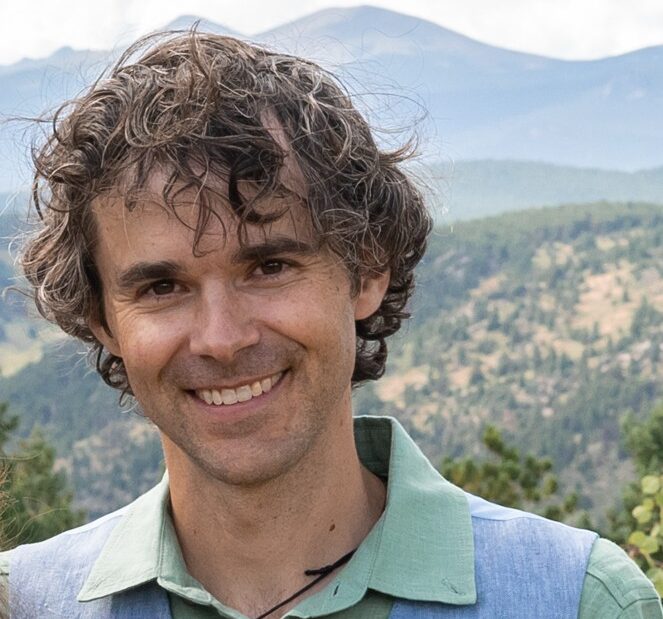
I work at the City of Longmont’s Water Quality Laboratory. I oversee the city’s drinking water, wastewater, creek, and reservoir sampling programs. This role requires me to have an intimate knowledge of applicable regulations and sampling protocols to ensure that the water samples collected and analyzed provide accurate data. My work is instrumental in protecting public health and the environment. I love to sing and write songs. I play several instruments including the guitar, banjo, and ukelele.

I spent a lot of time in nature from a young age and I’ve carried that appreciation for the environment through my whole life. In college I majored in Biological Sciences with a focus on Environmental Ethics with the goal of working in environmental protection in some capacity.
My first job out of college was in a microscopy lab, where I used a microscope to identify mold in samples. When the opportunity arose to move to Colorado, I welcomed the chance for a career change that would allow me to work more closely with the environment.
I started as a lab technician at the City of Longmont’s water quality lab. This job got me to where I wanted to be – in a science-based role where public health and environmental protection was the focus. Over the course of 17 years, I have gone from a lab technician to a water quality analyst to a specialist leading our watershed monitoring program. Right now, I am working to develop a program that takes the sampling information we gather and turns it into actionable steps we can take to help public health and the natural environment.

The Colorado Department of Public Health and Environment and the Environmental Protection Agency both set requirements that drinking water and wastewater treatment facilities need to meet. I need to understand what requirements the city’s facilities need to meet and plan our water quality monitoring accordingly.
I analyze the data we collect to check if we are following those state and federal regulations, but also to see if there are any trends we need to be concerned about. Drinking and wastewater requirements are pretty straightforward, but there is a lot more nuance when I assess the water quality in our rivers and streams. We need to look at weather and recent natural disasters or pollution events that could be causing shifts in our watershed conditions that could be a concern for aquatic life and public health. I also work to develop tools that make the data analysis process more efficient.
Communication is a big part of my job. I communicate with my workgroup daily about our projects. I also need to be ready to communicate data anomalies, trends, concerns, or compliance issues quicky and effectively to the right people. If there is an issue with any drinking and wastewater treatment sampling, my team identifies who needs to know about the issue and we provide them with the information they need to decide how to proceed. With so many city departments working on broader watershed health, it is easy to be siloed and focus only on your part of the puzzle. Communication breaks down these barriers and ensures we are not duplicating efforts.
I have a great appreciation for the beautiful and accessible public lands we have in Colorado. Being able to work in a field that protects the rivers and reservoirs in my own community gives me a great deal of satisfaction. I’m lucky that I can collaborate with people across the region who are just as passionate about their work as I am.
Explore what you’re curious about and pursue your passions. Volunteer for opportunities you’re interested in to figure out what opportunities there are in different fields. Be sure to take advantage of the resources your school and college provide, like guidance counselors and career advisors.